The short answer: Earth's core weighs roughly 1.9 × 10²⁴ kilograms (about 2.1 × 10²¹ US tons), making it close to a third of the entire planet's mass.
Earth's core weight by type
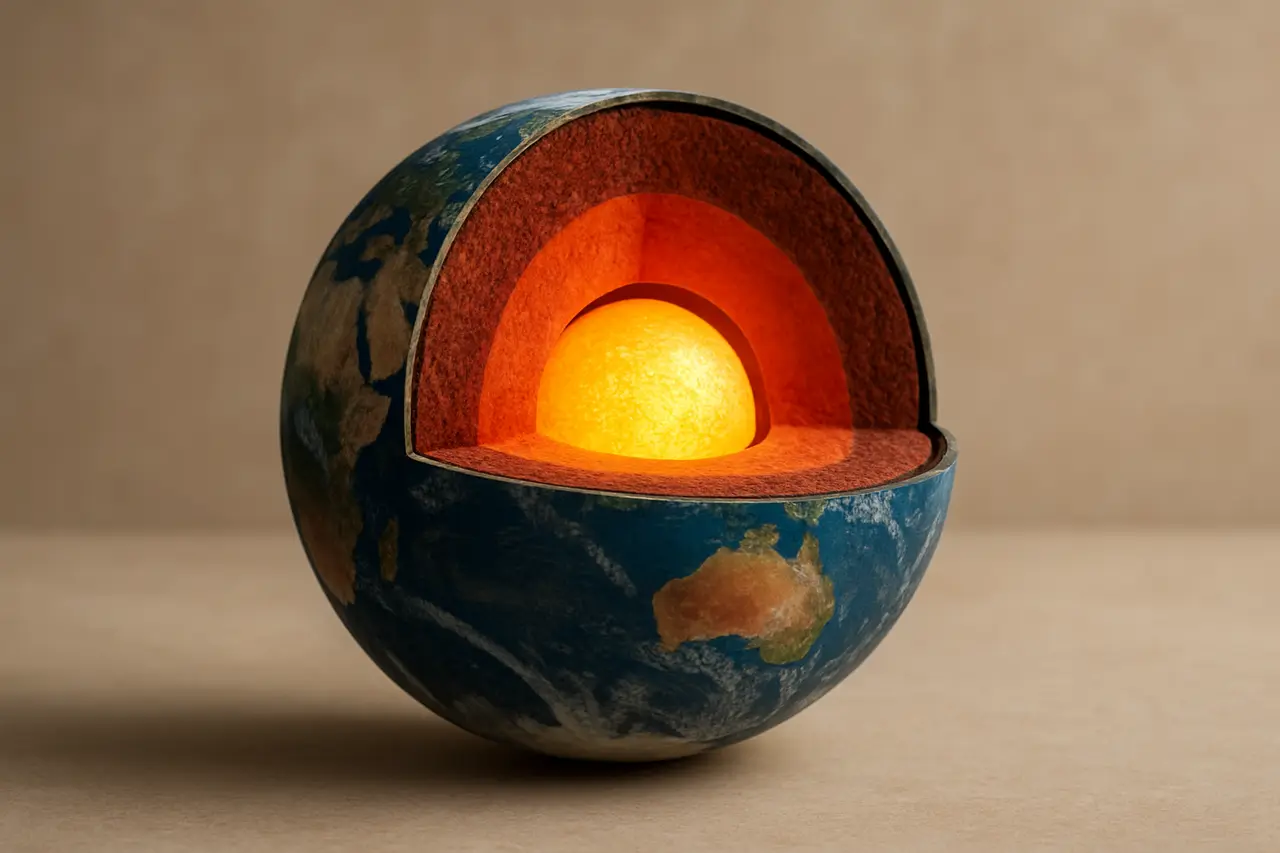
Earth's core is split into a solid inner core and a liquid outer core, both made mostly of iron and nickel. Its mass is estimated from the planet's total mass and the density inferred from seismic waves.
| Region (example) | Estimated mass |
|---|---|
| Inner core (solid) | about 1.0 × 10²³ kg |
| Outer core (liquid) | about 1.8 × 10²⁴ kg |
| Whole core combined | roughly 1.9 × 10²⁴ kg |
| Share of Earth's mass | roughly 32% |
What affects earth's core weight
- Density. The core's iron-nickel makeup gives it a far higher density than the rocky mantle above it.
- Volume. The core's radius of about 3,485 km sets how much material it contains.
- Pressure. Immense pressure compresses core material, raising its density beyond surface iron.
- Composition. Small amounts of lighter elements like sulfur or oxygen slightly lower the estimate.
- Seismic modeling. Estimates rely on how earthquake waves travel through the interior.
How earth's core weight compares
The core's mass is roughly the same as about 300 billion of the largest pyramids stacked together, and it accounts for nearly a third of the whole Earth's weight.
Frequently asked questions
Why is the core so heavy compared to its size?
The core is made mostly of iron and nickel, which are much denser than the silicate rocks of the mantle and crust. That density means it holds about a third of Earth's mass in a relatively small volume.
How do scientists weigh something they can't reach?
They calculate Earth's total mass from gravity, then use seismic waves to map the density of each interior layer. Subtracting the crust and mantle leaves an estimate for the core.
Is the inner or outer core heavier?
The outer core is heavier overall because it is much larger in volume, even though both are dense iron-nickel material. The solid inner core makes up only a small fraction of the total core mass.