The short answer: The Sahara's sand and surface material is estimated to weigh on the order of 10 trillion metric tons (about 11 trillion US tons), though figures vary widely with how much depth is counted.
Sahara desert weight by type
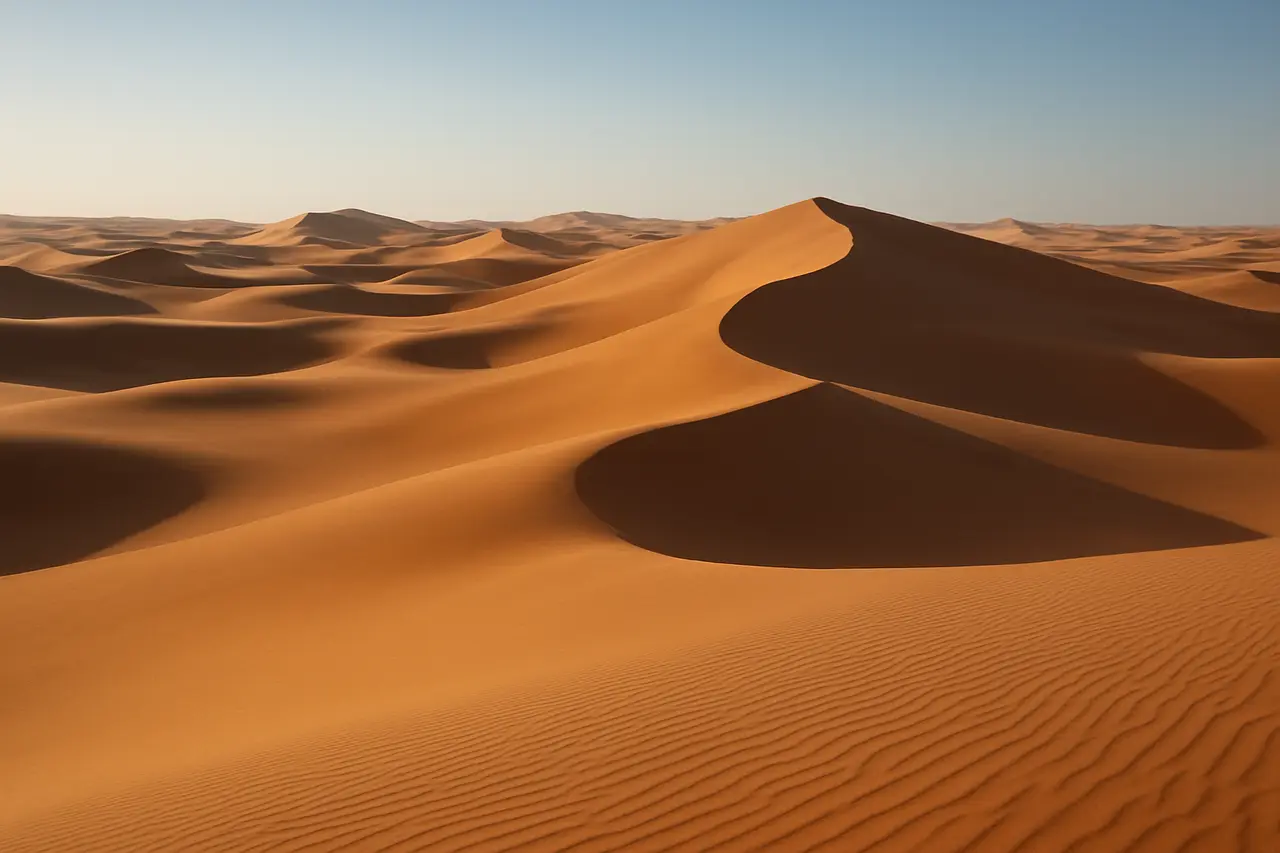
The Sahara is the world's largest hot desert, covering roughly 9.2 million square kilometers of North Africa. Any weight estimate depends heavily on how deep the sand and rock are assumed to go.
| Terrain type (example) | Rough share / weight note |
|---|---|
| Sand seas (ergs) | deep dunes, heaviest contribution |
| Rocky plateaus (hamadas) | thin sediment over bedrock |
| Gravel plains (regs) | shallow coarse material |
| Total surface estimate | on the order of 10 trillion tons |
What affects sahara desert weight
- Depth counted. Including only loose sand versus deep deposits changes the total enormously.
- Sand density. Dry sand weighs roughly 1,500–1,700 kg per cubic meter.
- Area. The desert's 9.2 million km² footprint multiplies any depth assumption.
- Terrain mix. Sand seas, rocky plateaus, and gravel plains all weigh differently.
- Moisture. Even small amounts of water in the sand raise the total mass.
How sahara desert weight compares
Estimates on the order of 10 trillion tons make the Sahara's surface roughly a billion times heavier than the Great Pyramid of Giza, underscoring how rough such planet-scale figures are.
Frequently asked questions
Why is the Sahara's weight so hard to pin down?
There is no clear bottom to measure, so the figure depends entirely on how deep the sand and rock are counted. Different depth assumptions can shift the estimate by orders of magnitude.
Is the Sahara all sand?
No, sand seas make up only part of it. Much of the Sahara is rocky plateau and gravel plain, which weigh differently from deep dunes.
How much does Sahara sand weigh per cubic meter?
Dry desert sand typically weighs around 1,500 to 1,700 kilograms per cubic meter. That density is the basis for scaling up to the whole desert.