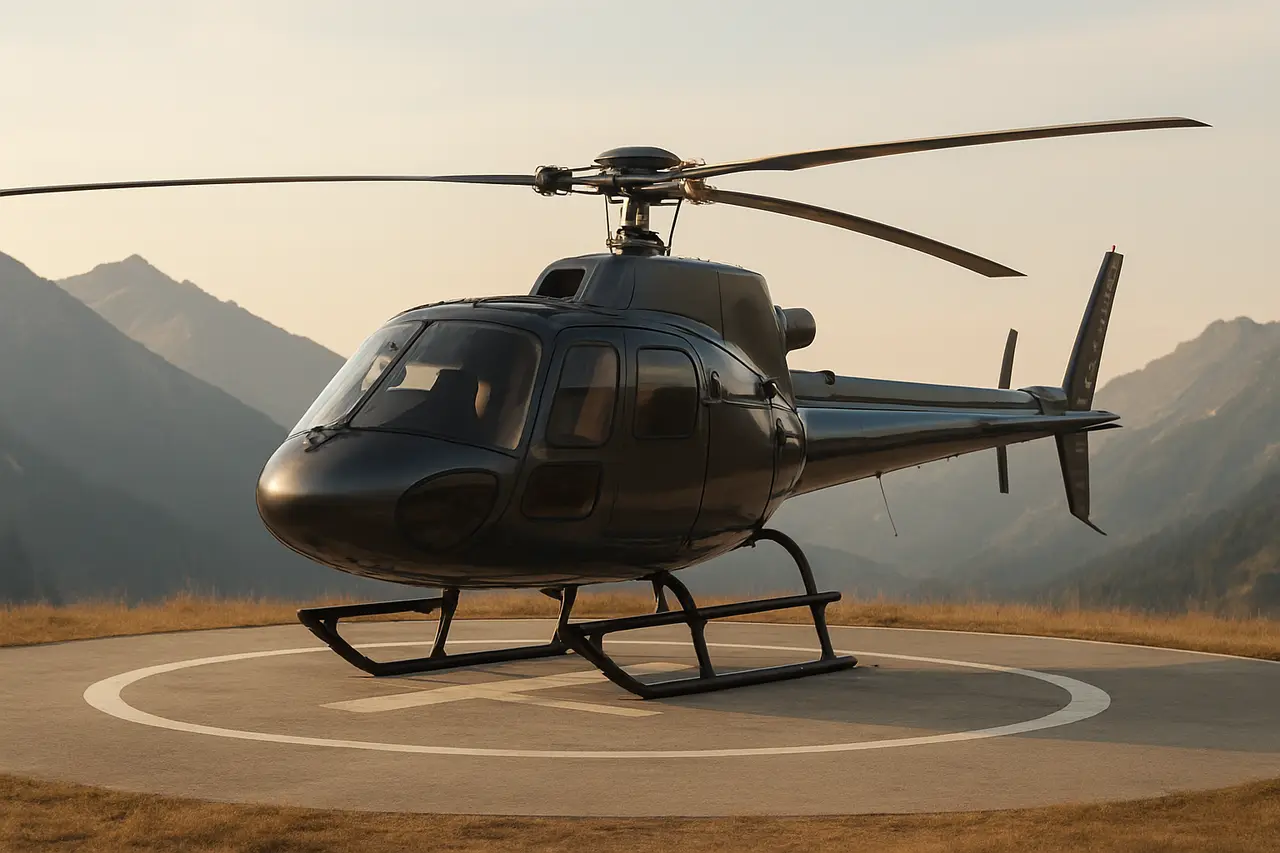
The short answer: A typical small civilian helicopter weighs about 600 kg to 1.5 t (roughly 1,300 to 3,300 lb) empty. Light training and personal helicopters sit at the low end, while heavy transport machines can reach 11 t empty and over 22 t at maximum takeoff weight. The single most important distinction is between empty weight (the aircraft alone) and maximum takeoff weight (MTOW), the heaviest it is allowed to lift off with fuel, crew, and payload.
Helicopter weight by type
Helicopters range from tiny two-seat trainers to twin-rotor heavy lifters. Use the table below to estimate the weight of a given class, with empty weight and maximum takeoff weight (MTOW) side by side.
| Helicopter type (example) | Empty weight | Max takeoff weight (MTOW) |
|---|---|---|
| Light piston, 2-seat (Robinson R22) | ~390 kg (860 lb) | ~620 kg (1,370 lb) |
| Light piston, 4-seat (Robinson R44 class) | ~680 kg (1,500 lb) | ~1,090 kg (2,400 lb) |
| Light turbine (Bell 206 JetRanger class) | ~700–800 kg (1,550–1,760 lb) | ~1,450 kg (3,200 lb) |
| Medium twin (Bell 412 / AW139 class) | ~3.5–4.5 t (7,700–9,900 lb) | ~5.4–7 t (11,900–15,400 lb) |
| Heavy transport (CH-47 Chinook class) | ~11 t (24,000 lb) | ~22 t (50,000 lb) |
What changes a helicopter's weight
- Size and number of seats. A two-seat trainer weighs a fraction of a 15-seat transport helicopter.
- Engine type. Piston engines are common on light models, while heavier turbine engines power larger, faster helicopters and add weight.
- Fuel load. A full fuel tank can add hundreds of kilograms, which is why MTOW is well above empty weight.
- Passengers and cargo. People, baggage, and slung loads all count toward the takeoff weight.
- Mission equipment. Rescue hoists, sensors, medical gear, or weapons add weight and reduce available payload.
How a helicopter compares
A light Robinson R22 at around 620 kg weighs about the same as a small car. An empty CH-47 Chinook at roughly 11 t is in the range of several SUVs or a loaded city bus. The spread from lightest to heaviest helicopter is enormous, so always check whether a figure is empty weight or MTOW.
Weighing and converting
Manufacturers publish helicopter weights in their specifications, usually listing both empty weight and maximum takeoff weight. To switch between metric and imperial units, remember that 1 t = 1,000 kg ≈ 2,205 lb. So a 620 kg light helicopter is about 1,370 lb, and a 22 t Chinook at MTOW is close to 48,500 lb (often rounded to 50,000 lb).
Frequently asked questions
How much does an average small helicopter weigh?
A typical small civilian helicopter weighs about 600 kg to 1.5 t (1,300 to 3,300 lb) empty. A light two-seat Robinson R22 is near 390 kg empty with a 620 kg (1,370 lb) maximum takeoff weight.
What is the difference between empty weight and maximum takeoff weight?
Empty weight is the aircraft alone with no crew, passengers, cargo, or usable fuel. Maximum takeoff weight (MTOW) is the heaviest it is certified to lift off with everything loaded, and it is always higher than empty weight.
What are the heaviest helicopters?
Heavy-lift transport helicopters such as the CH-47 Chinook class weigh about 11 t empty and up to roughly 22 t (around 50,000 lb) at maximum takeoff weight, among the heaviest in regular service.
What does a Black Hawk or Chinook weigh?
A UH-60 Black Hawk is roughly 5 t empty and about 9 to 10 t at maximum takeoff weight, while the larger twin-rotor CH-47 Chinook is about 11 t empty and up to roughly 22 t fully loaded.
What determines how much a helicopter weighs?
The biggest factors are size and seat count, piston versus turbine engine, fuel load, passengers and cargo, and any mission equipment such as hoists, sensors, or weapons.