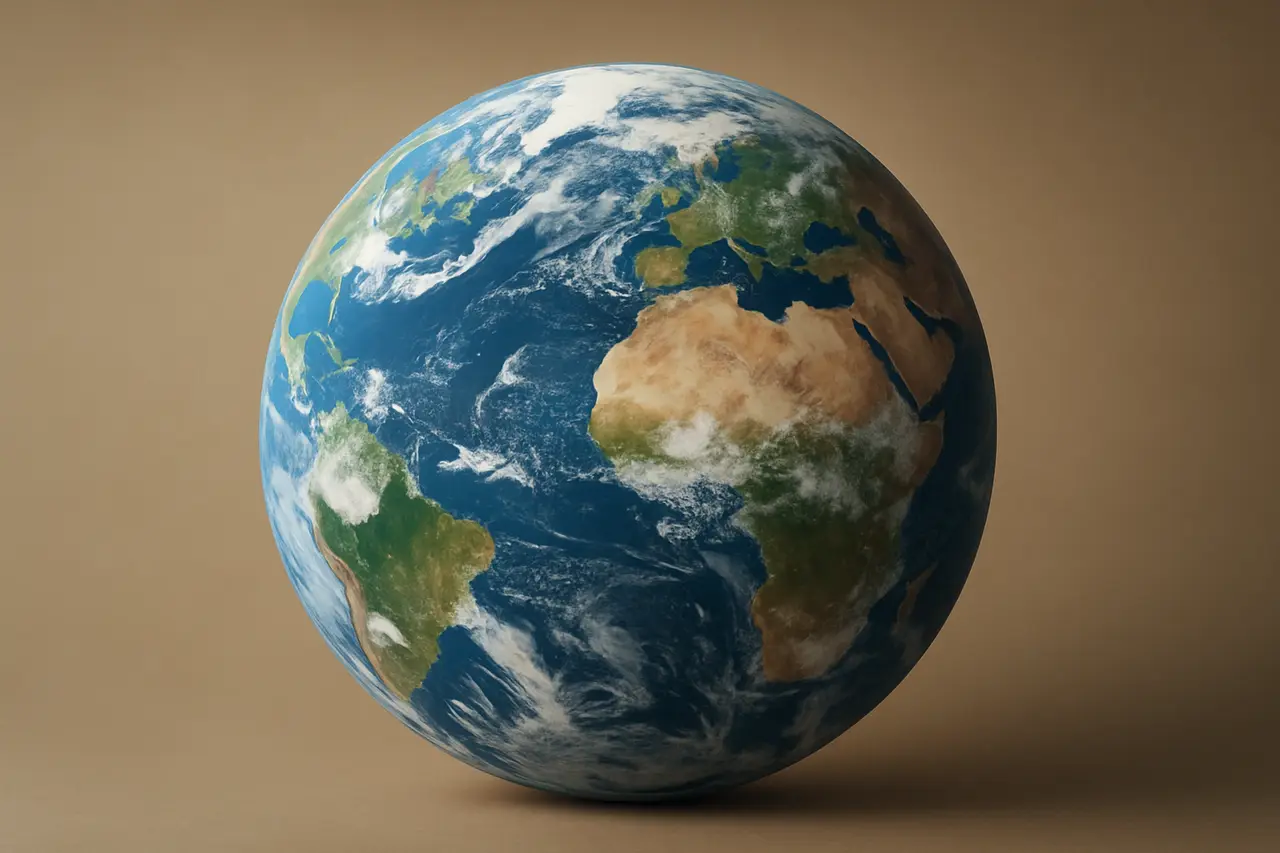
The short answer: Earth has a mass of about 5.97 × 1024 kg (roughly 1.32 × 1025 lb, or about 6.6 sextillion tons).
Earth weight by type
Earth's "weight" is more precisely its mass, a measure of all the matter it contains, from its iron core to its oceans and atmosphere.
| Component | Approximate share of mass |
|---|---|
| Core (iron and nickel) | about 32% |
| Mantle (rock) | about 67% |
| Crust | less than 1% |
| Oceans | about 0.02% |
| Atmosphere | about 0.0001% |
What affects Earth weight
- Core composition. The dense iron-nickel core holds a large share of Earth's total mass.
- Mantle volume. The thick rocky mantle makes up roughly two-thirds of the planet's mass.
- Density. Earth is the densest planet in the solar system at about 5.51 g/cm³.
- Measurement via gravity. Earth's mass is derived from its gravitational constant and radius, not by weighing it directly.
- Tiny outer layers. Oceans and atmosphere add only a small fraction to the overall total.
How Earth weight compares
Earth is about 81 times heavier than the Moon, yet the Sun is roughly 333,000 times more massive than Earth.
Frequently asked questions
Does Earth actually have a weight?
Technically Earth has mass rather than weight, because weight depends on gravity from another body. Scientists describe its mass as about 5.97 × 10²⁴ kilograms.
How did scientists measure Earth's mass?
Earth's mass was first calculated using Newton's law of gravitation and the gravitational constant measured in the Cavendish experiment. Knowing gravity and the planet's radius lets us solve for mass.
Is Earth getting heavier over time?
Earth's mass changes only very slightly. It gains a bit from incoming space dust and meteorites and loses tiny amounts of light gases from the upper atmosphere, but the net change is negligible.