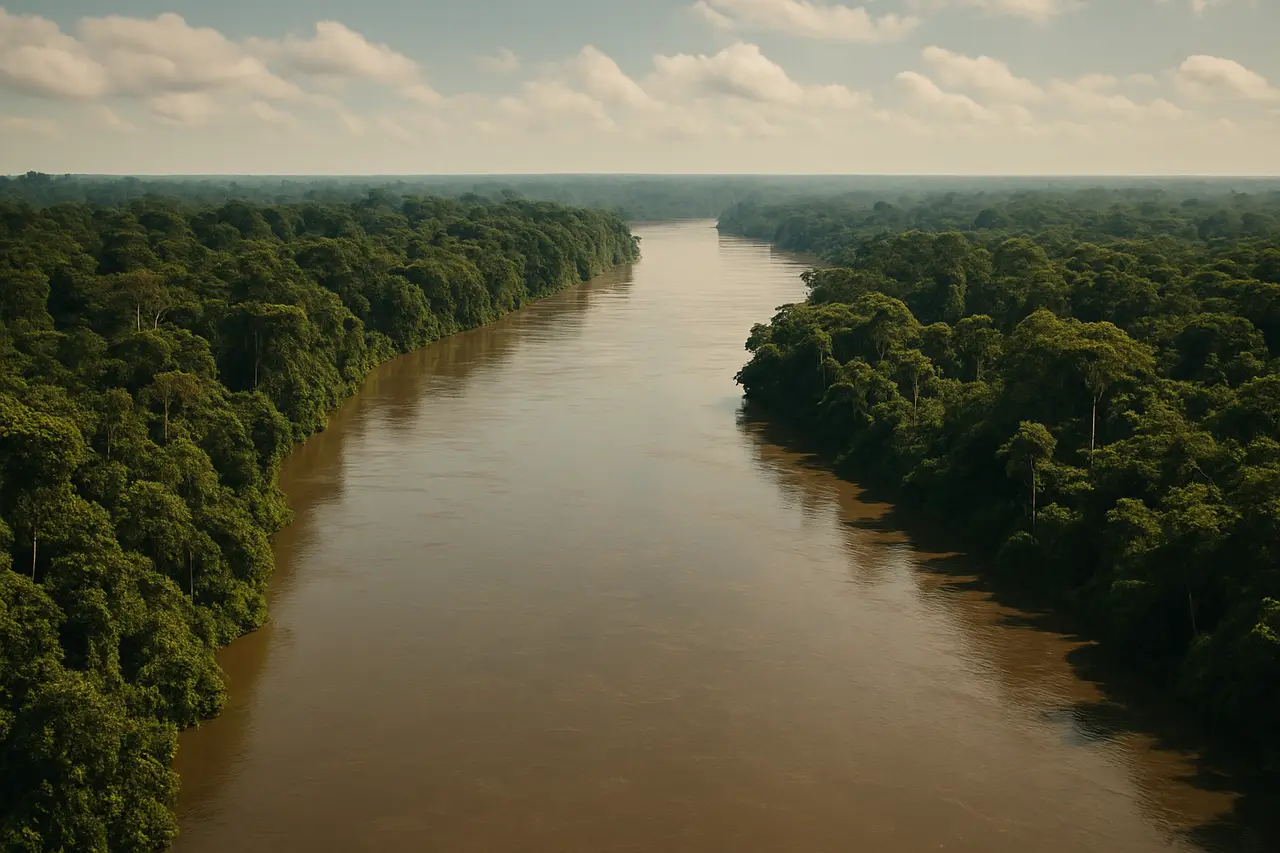
The short answer: The Amazon River carries about 209,000 cubic meters of water per second, so at any moment roughly 209 million kilograms (about 460 million pounds) of water flows past a given point each second, using fresh water's density of 1,000 kg per cubic meter.
Amazon River weight by type
The Amazon's weight is best expressed as the mass of water flowing through it, since a river has no fixed total. It is the largest river by discharge, carrying about a fifth of all freshwater reaching the oceans.
| Flow context (example) | Approximate water mass |
|---|---|
| Water passing per second (average) | about 209 million kg |
| Water passing per minute | about 12.5 billion kg |
| High-water (wet season) flow | well above average |
| Low-water (dry season) flow | below average |
What affects Amazon River weight
- Discharge rate. The cubic meters per second flowing past sets the moment-to-moment mass.
- Season. Wet-season flows can far exceed the average discharge.
- Tributaries. Hundreds of tributaries feed water into the main channel.
- Rainfall in the basin. Heavy basin rainfall raises the river's flow.
- Water density. The river is fresh water at about 1,000 kg per cubic meter.
- Measurement point. Flow grows downstream as more water joins.
How Amazon River weight compares
The water passing through the Amazon each second weighs about as much as 30,000 elephants, and in a single minute it moves more water than many smaller rivers carry in a year.
Frequently asked questions
Why express the Amazon's weight as flow?
A river is constantly moving water, so there is no fixed total mass. The most meaningful figure is how much water mass flows past a point each second.
How much of the world's freshwater does the Amazon carry?
About 20 percent of all the freshwater discharged into the world's oceans flows through the Amazon, making it the largest river by volume.
Does the Amazon's flow change through the year?
Yes, considerably. Discharge rises sharply in the wet season and falls in the dry season, so the moment-to-moment water mass varies a great deal.