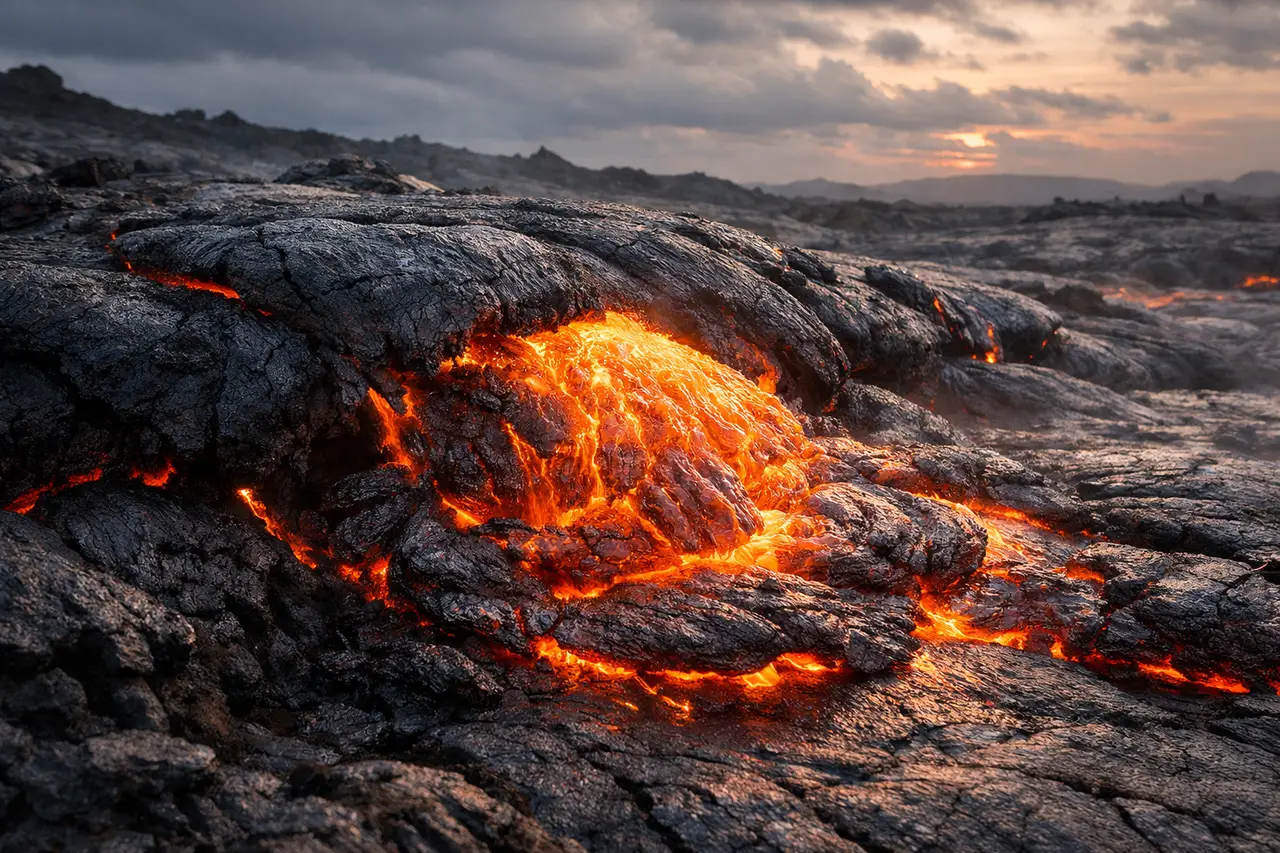
The short answer: Lava typically weighs about 2,600 to 3,100 kilograms per cubic meter (roughly 160 to 195 lb per cubic foot), depending on its composition and trapped gases. Basaltic lava sits near the lower end, while denser silica-rich material can be heavier.
Lava weight by type
Lava's weight is set mainly by its chemistry and how much gas it holds, not by how hot it glows. Direct weighing is impractical, so densities are measured from cooled rock samples.
| Lava type (example) | Approximate weight per cubic meter |
|---|---|
| Frothy, gas-rich lava | about 2,200-2,600 kg |
| Basaltic lava (low silica) | about 2,600-2,900 kg |
| Andesitic lava | about 2,800-3,000 kg |
| Dense silica-rich lava | about 3,000-3,100 kg |
What affects lava weight
- Composition. Silica and mineral content shift the base density of the molten rock.
- Gas content. Trapped bubbles make frothy lava lighter per volume.
- Temperature. Hotter, more fluid lava is slightly less dense than cooler lava.
- Crystallization. Forming crystals as lava cools can increase density.
- Water and volatiles. Dissolved gases lower the effective weight.
- Vesicularity. Porous, bubble-filled lava weighs far less than solid rock.
How lava weight compares
A single cubic meter of lava can weigh nearly three tons, about as much as a large pickup truck, and far more than the same volume of water or solid concrete.
Frequently asked questions
Is lava heavier than water?
Yes, by a lot. Lava is roughly 2.6 to 3.1 times denser than water, which is why it can sink and crush objects in its path.
Why is some lava lighter than others?
Composition and gas content are the main reasons. Gas-rich, frothy lava traps bubbles that lower its density, while dense silica-rich lava is heavier.
How do scientists measure lava's weight?
They sample and weigh cooled lava rock of known volume, since measuring molten lava directly is far too dangerous.