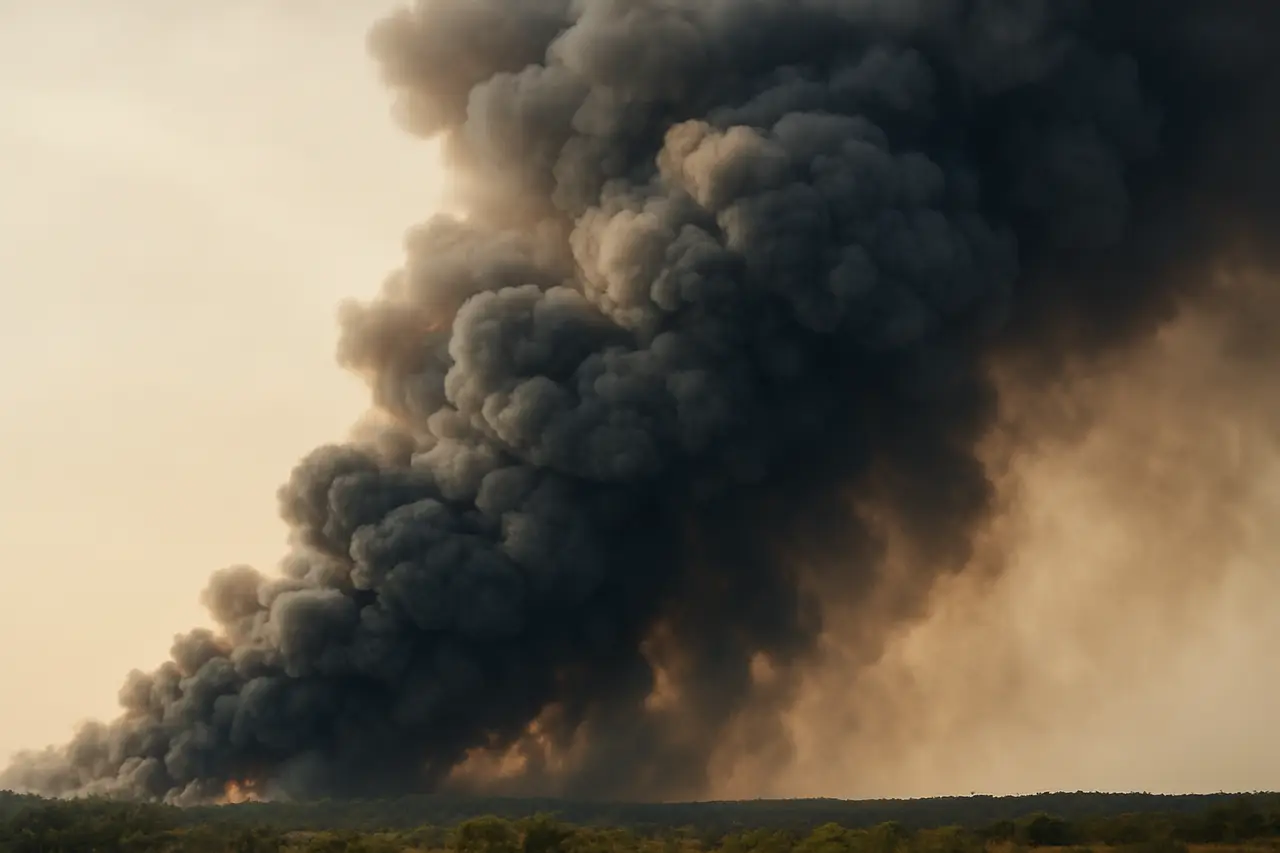
The short answer: A cloud of smoke from a large fire can weigh roughly several hundred to several thousand kilograms (hundreds to thousands of pounds), depending on its size and particle density.
Cloud of smoke weight by type
A smoke cloud is made of tiny solid particles and gases suspended in air. Most of its measurable weight comes from the particulate matter rather than the hot air itself.
| Smoke source (example) | Rough particulate weight |
|---|---|
| Small campfire plume | a few grams to kilograms |
| House fire smoke cloud | tens to hundreds of kilograms |
| Large building fire | hundreds to thousands of kg |
| Wildfire smoke column | many tons of particulates |
What affects cloud of smoke weight
- Cloud size. A larger volume of smoke holds proportionally more particles.
- Particle concentration. Dense, dark smoke carries more mass than thin haze.
- Fuel type. Burning oily or heavy materials produces heavier, sootier smoke.
- Combustion efficiency. Incomplete burning releases more solid particulates.
- Dispersion. As smoke spreads and thins, its density per cubic meter falls.
How cloud of smoke weight compares
A few thousand kilograms of suspended soot is roughly the weight of a small car spread invisibly through the air, even though the smoke looks weightless.
Frequently asked questions
Does smoke really have weight?
Yes, smoke contains tiny solid particles and gases that have mass. The visible cloud can weigh hundreds or thousands of kilograms for a large fire.
Why does smoke rise if it has weight?
Smoke rises because the hot gases carrying the particles are less dense than the surrounding cooler air. The buoyancy of hot air overcomes the small weight of the particles.
What makes some smoke heavier than others?
Thicker, darker smoke from oily or smoldering fuels carries more solid particulate matter. That higher particle concentration makes the cloud weigh more.