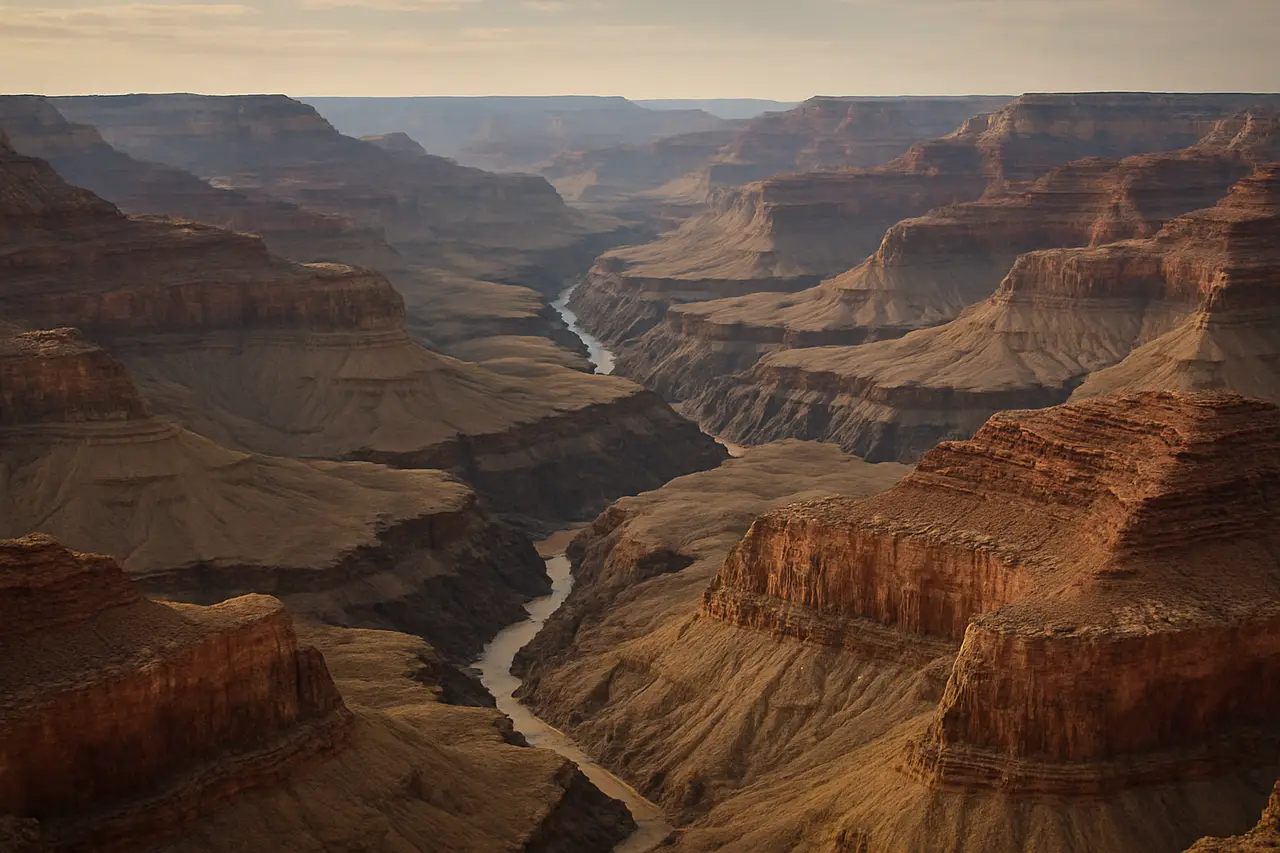
The short answer: Canyon weights vary enormously, but the rock removed to form the Grand Canyon is estimated on the order of roughly a quadrillion metric tons (about 1.5 × 10^15 t). The figure is a rough estimate based on volume and rock density.
Canyon weight by type
A canyon is a deep, steep-sided valley carved by river erosion over millions of years. Asking its weight usually means the mass of rock involved, which depends on the canyon's size and rock density.
| Canyon (example) | Rough order of magnitude |
|---|---|
| Small slot canyon | millions of metric tons |
| Medium river canyon | billions of metric tons |
| Large canyon | trillions of metric tons |
| Grand Canyon (rock mass) | around 10^15 metric tons |
| Material eroded away | comparable enormous figures |
What affects canyon weight
- Volume. Length, width, and depth together set the overall scale of rock involved.
- Rock density. Denser rock layers add more mass per cubic meter.
- Rock type. Sandstone, limestone, and granite each weigh different amounts.
- How you define it. Counting the walls versus the eroded material gives different totals.
- Estimation method. All such figures are approximations from geometry and density.
- Erosion over time. The shape and mass keep changing across geologic timescales.
How canyon weight compares
The rock involved in a canyon like the Grand Canyon is so vast that it dwarfs human-made structures entirely; even the largest dams and skyscrapers are a tiny fraction of its mass.
Frequently asked questions
How much does a canyon weigh?
It depends entirely on the canyon's size, but large canyons involve rock masses on the order of trillions to quadrillions of metric tons. The Grand Canyon is estimated at roughly 10^15 metric tons of rock.
How is a canyon's weight estimated?
Geologists estimate the volume of rock from the canyon's dimensions and multiply by the average density of its rock layers. The result is always an approximation.
Does a canyon's weight change over time?
Yes, slowly. Ongoing erosion removes material and reshapes the canyon over millions of years, gradually changing the mass of rock present.