The short answer: Earth's mantle weighs roughly 4.0 × 10²⁴ kilograms (about 4.4 × 10²¹ US tons), making it by far the most massive layer of the planet.
Earth's mantle weight by type
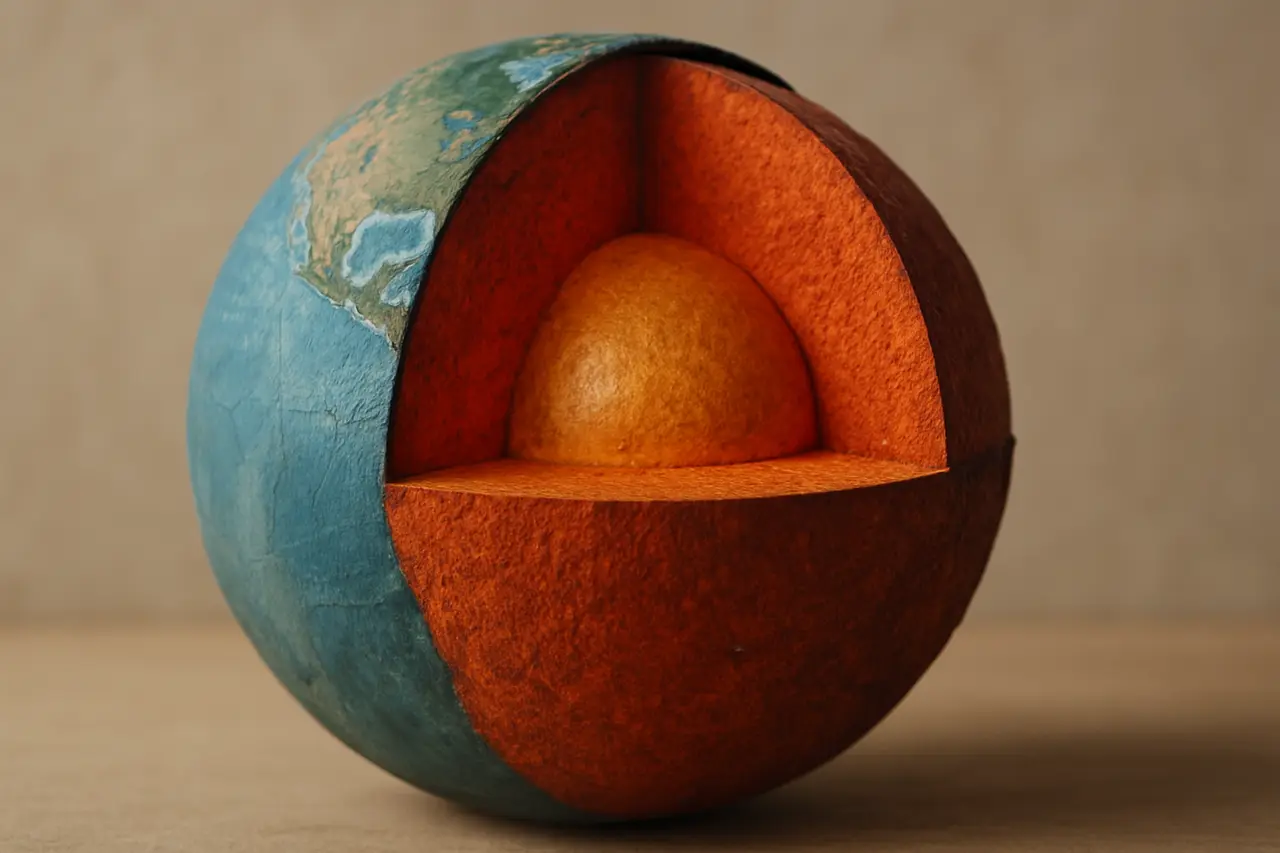
The mantle lies between the crust and the core and makes up the bulk of Earth's volume. It is composed mainly of dense silicate rocks rich in iron and magnesium.
| Layer (example) | Estimated mass / depth |
|---|---|
| Upper mantle | about 1.0 × 10²⁴ kg, to ~660 km |
| Lower mantle | about 3.0 × 10²⁴ kg, to ~2,900 km |
| Whole mantle combined | roughly 4.0 × 10²⁴ kg |
| Share of Earth's mass | roughly 67% |
What affects earth's mantle weight
- Volume. The mantle accounts for about 84% of Earth's volume, driving its large mass.
- Density. Silicate rock here is denser than crust but lighter than the iron core.
- Depth range. The mantle stretches roughly from the crust down to about 2,900 km.
- Pressure. Increasing pressure with depth compresses the rock and raises its density.
- Composition. Iron- and magnesium-rich minerals set the typical density used in estimates.
How earth's mantle weight compares
The mantle holds about two-thirds of Earth's entire mass, dwarfing the thin crust and outweighing even the dense metallic core.
Frequently asked questions
Why is the mantle the heaviest layer?
The mantle takes up about 84% of Earth's volume, so even at moderate density it holds the most mass. It accounts for roughly two-thirds of the entire planet's weight.
Is the mantle solid or liquid?
The mantle is mostly solid rock, but it slowly flows over geologic time through convection. This movement drives plate tectonics at the surface.
How deep does the mantle go?
It extends from beneath the crust, roughly 35 kilometers down, to about 2,900 kilometers where the core begins. That huge depth range is why it dominates Earth's mass.