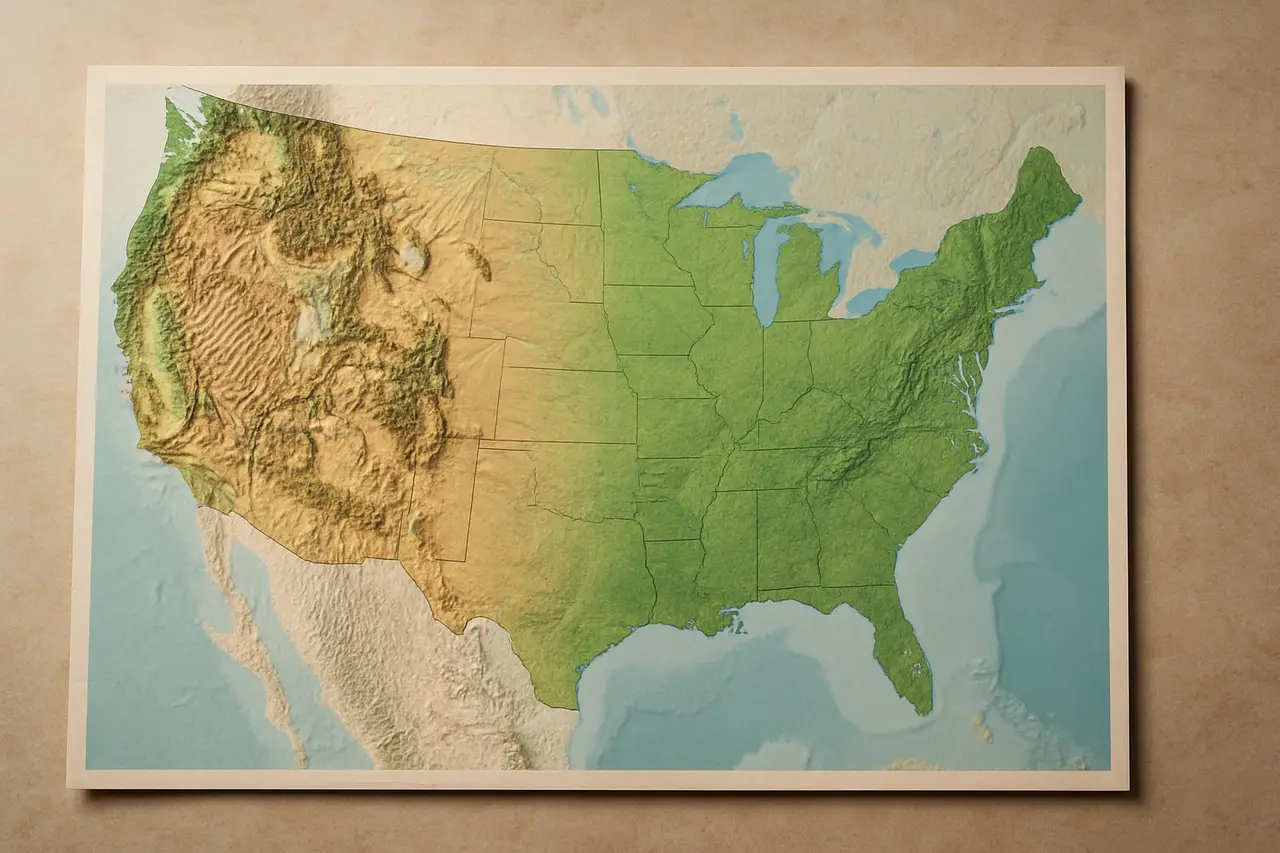
The short answer: The landmass of the USA is estimated to weigh about 2.6 x 10^15 kilograms (2.6 quadrillion kilograms), based on the average density of Earth's crust and the country's surface area of roughly 9.8 million square kilometers.
USA weight by type
The USA's weight here refers to a shallow layer of its landmass, since counting the full crust depth would give a vastly larger number. The figure scales with how deep into the ground you measure.
| What is counted | Approximate weight scale |
|---|---|
| Buildings and infrastructure | billions of tons |
| Surface soil layer | quadrillions of tons |
| Shallow landmass layer | about 2.6 x 10^15 kg |
| Full continental crust column | far higher still |
What affects USA weight
- Surface area. The USA's roughly 9.8 million square kilometers drives the total.
- Depth counted. A shallow layer gives one figure; deeper crust multiplies it.
- Crust density. Continental crust averages around 2,700 kg per cubic meter.
- Terrain. Mountains add more rock mass than plains and basins.
- Water and ice. Lakes, rivers, and Alaskan ice add to the mass.
- Built environment. Cities and roads are a tiny share of the whole.
How USA weight compares
Even a shallow slice of the USA's landmass at about 2.6 quadrillion kilograms outweighs the entire human-built world many times over, and the land dwarfs everything constructed on it.
Frequently asked questions
Why does the USA's weight depend on depth?
Land has no natural lower boundary, so the estimate depends on how deep into the crust you count. A thin surface layer gives a smaller figure than the full crust.
How is the figure calculated?
Scientists multiply the country's surface area by a chosen layer depth and the average density of Earth's crust to reach an approximate mass.
How big is the USA by area?
The USA is the third-largest country by area, covering about 9.8 million square kilometers with landscapes from mountains to plains.