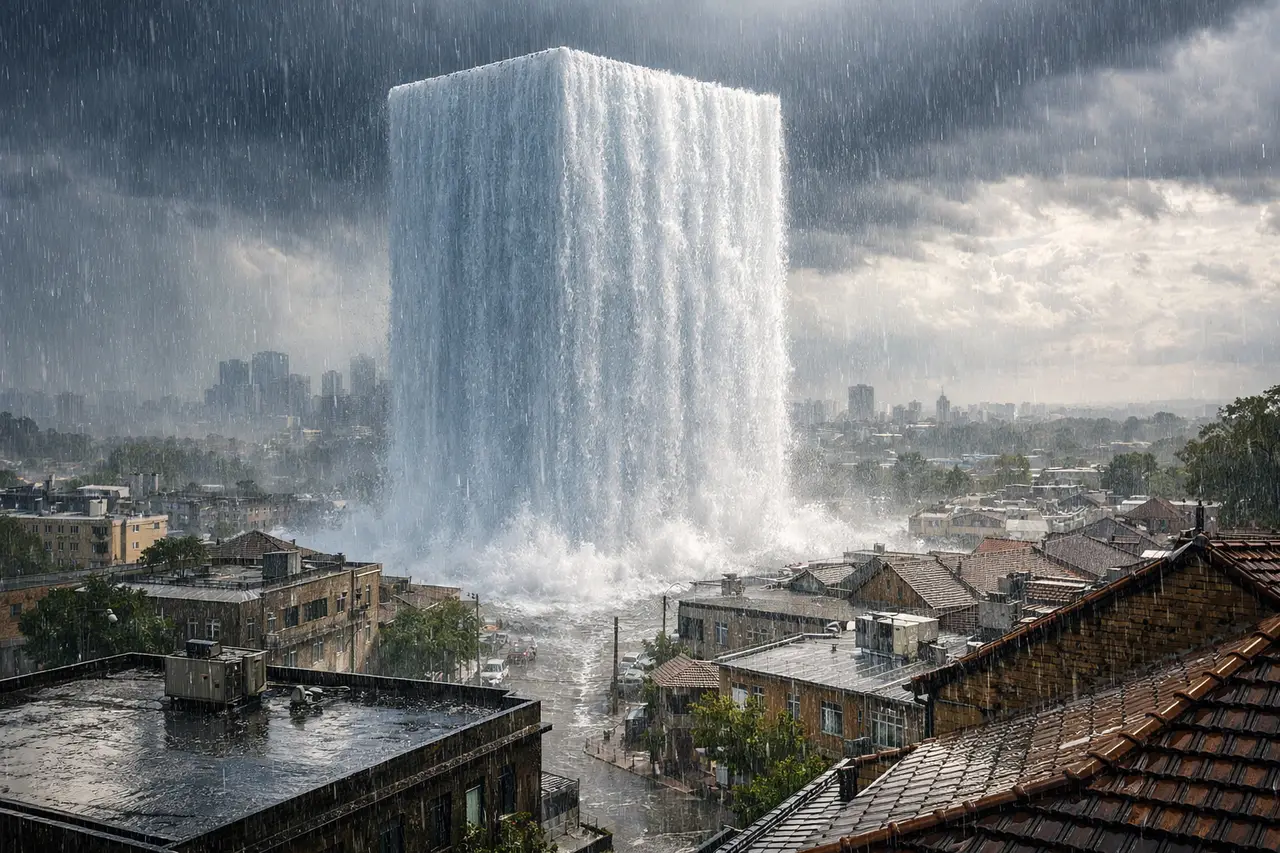
The short answer: Rain weighs 1 kilogram per square meter for every millimeter that falls (about 0.2 pounds per square foot per millimeter). So a 10-millimeter rain event over 1 square meter weighs 10 kilograms, and large storms add up fast.
Rain weight by type
Rain is one of the easiest natural phenomena to weigh because rainfall depth converts directly to mass. Every millimeter over a square meter equals one liter, or one kilogram, of water.
| Rainfall amount (example) | Weight per square meter |
|---|---|
| Light shower (2 mm) | 2 kg |
| Moderate rain (10 mm) | 10 kg |
| Heavy rain (50 mm) | 50 kg |
| Extreme storm (150 mm) | 150 kg |
What affects rain weight
- Rainfall depth. Each millimeter of rain adds one kilogram per square meter.
- Area covered. Larger areas multiply the total mass enormously.
- Storm intensity. Heavy storms deliver many millimeters in a short time.
- Duration. Longer rain events accumulate more total water.
- Water density. Rain is essentially fresh water at about 1,000 kg per cubic meter.
- Catchment size. Over a city or region the totals reach millions of tons.
How rain weight compares
A 25-millimeter rainfall over a single football field drops about 130 tons of water, roughly the weight of a fully loaded passenger jet, onto the grass.
Frequently asked questions
Why does one millimeter of rain equal one kilogram?
One millimeter of water over one square meter is exactly one liter, and one liter of water weighs one kilogram, so the conversion is direct.
How much does rain weigh over a whole city?
A heavy storm dropping tens of millimeters across a city covering many square kilometers delivers water weighing millions of tons.
Does the type of rain change its weight?
No. Whether it falls as drizzle or a downpour, a given depth of rain weighs the same per square meter; only the rate differs.