The short answer: Energy has a mass equivalent through E = mc^2. One joule corresponds to about 1.11 x 10^-17 kilograms (roughly 2.4 x 10^-17 pounds), an amount so tiny it is far below what ordinary scales can detect.
Energy weight by type
Energy is not matter, but Einstein's relation means any energy carries a mass equivalent. The amount is minuscule for everyday energies because the speed of light squared is so large.
| Energy amount (example) | Approximate mass equivalent |
|---|---|
| 1 joule | about 1.11 x 10^-17 kg |
| 1 kilowatt-hour | about 4 x 10^-11 kg |
| Energy in a AA battery (~10 kJ) | about 1.1 x 10^-13 kg |
| 1 megaton TNT (~4.2 x 10^15 J) | about 0.047 kg |
What affects energy weight
- Amount of energy. Mass equivalent rises directly with the number of joules.
- The c^2 factor. Dividing by the speed of light squared makes the mass extremely small.
- Form of energy. Kinetic, thermal, chemical, or electromagnetic energy all carry mass equivalent.
- System boundaries. Stored energy adds to a system's measured mass.
- Measurement limits. The effect is far below the sensitivity of ordinary scales.
- Nuclear scale. Only at nuclear or astronomical energies does the mass become noticeable.
How energy weight compares
The energy of a one-megaton nuclear blast weighs only about as much as a small grape, around 47 grams, which shows just how little mass everyday energy carries.
Frequently asked questions
Does a charged battery really weigh more?
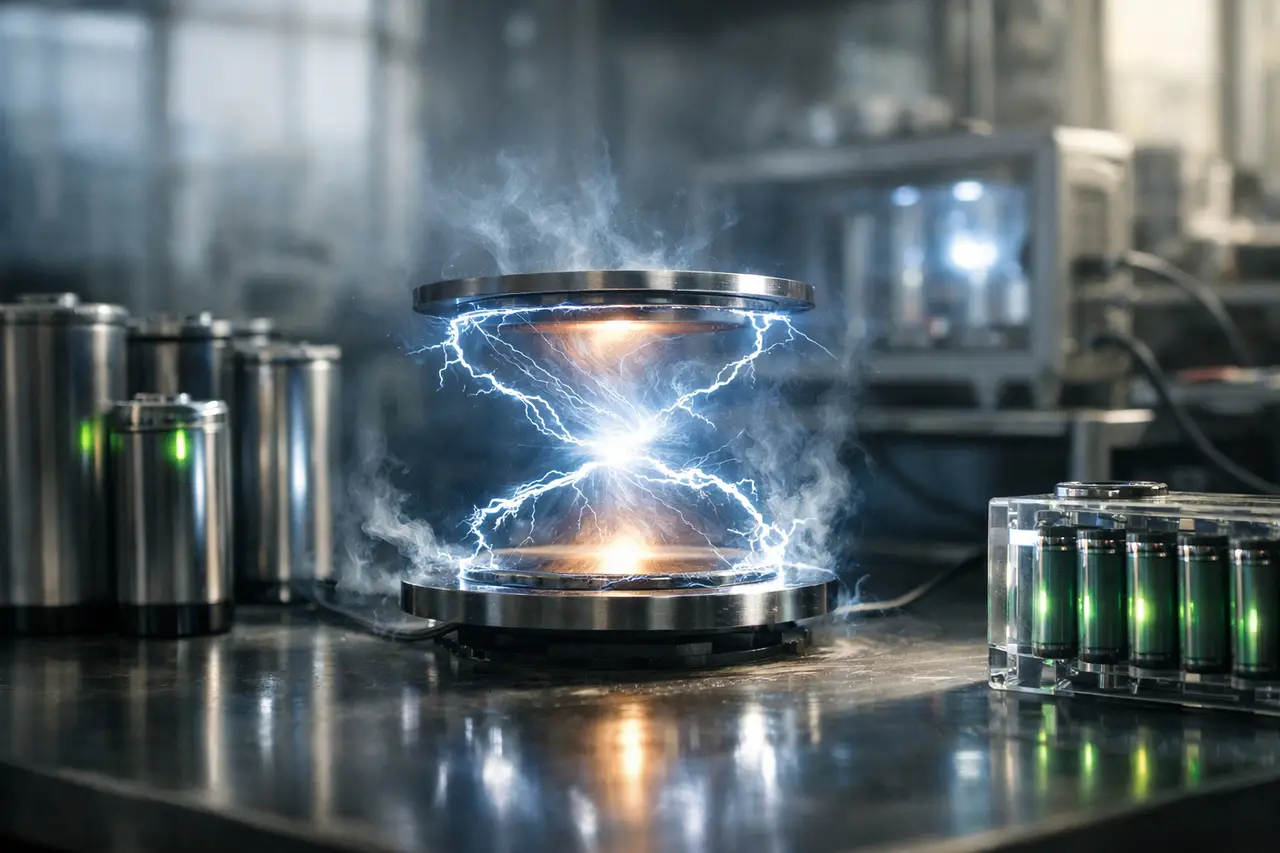
Yes, technically. A fully charged battery holds more energy and so has a slightly greater mass than when discharged, though the difference is far too small to measure on a scale.
Why is the mass of energy so small?
Because the conversion divides by the speed of light squared, an enormous number, so even large energies translate into tiny masses.
Can we ever weigh energy directly?
Not with everyday tools. The mass equivalent only becomes measurable at nuclear scales, such as the mass lost when atoms fuse or split.