The short answer: An iceberg can weigh anywhere from thousands of tons to billions of tons, depending on its size. Glacier ice weighs about 917 kg per cubic meter (roughly 57 lb per cubic foot), so even a modest berg holds an enormous mass of frozen water.
Iceberg weight by type
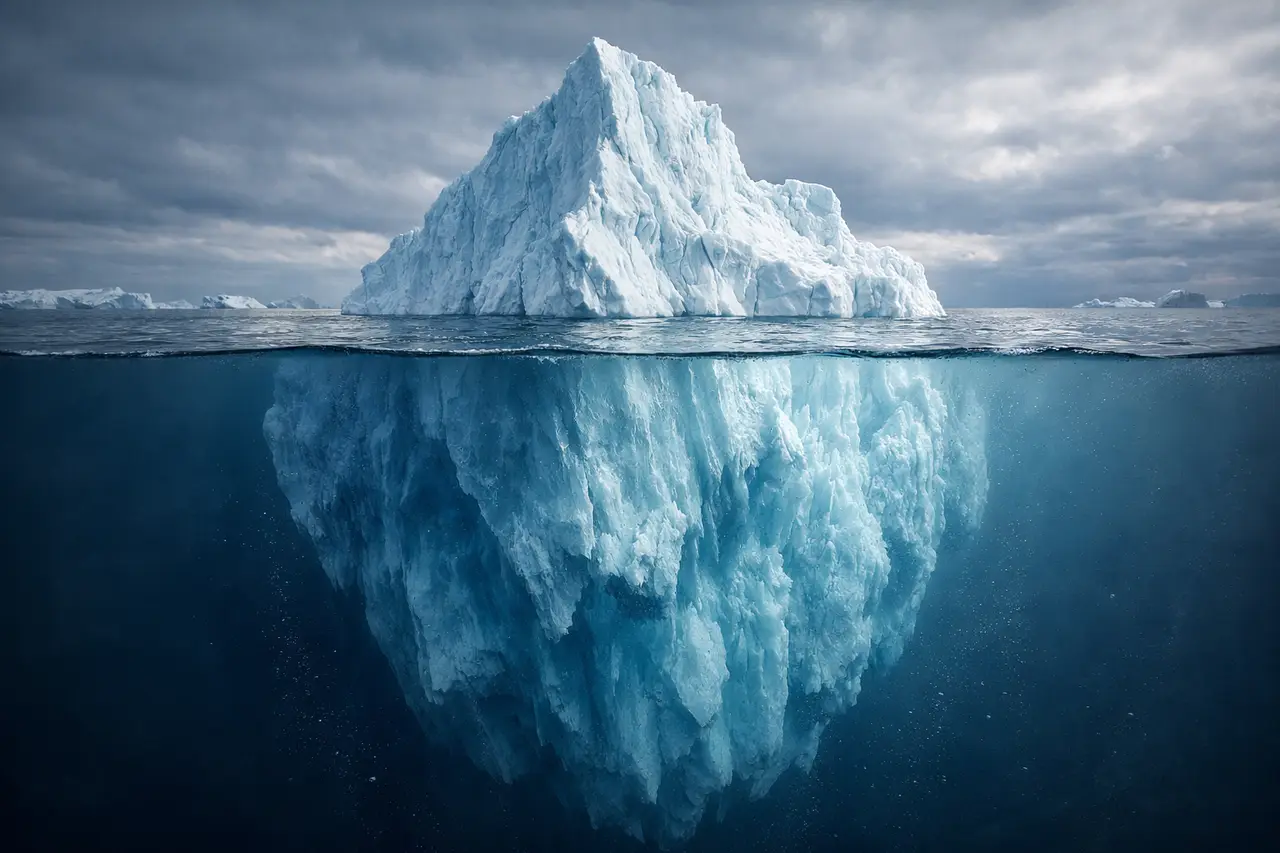
Icebergs are classified by size, and weight scales sharply with volume. Remember that about 90 percent of an iceberg sits hidden below the waterline.
| Iceberg size (example) | Approximate mass |
|---|---|
| Growler (under 1 m above water) | around 1 ton or less |
| Bergy bit (1-5 m above water) | thousands of tons |
| Medium iceberg (15-45 m above water) | millions of tons |
| Very large / tabular iceberg | billions of tons |
What affects iceberg weight
- Total volume. The dominant factor, including the large hidden portion underwater.
- Ice density. Glacier ice is about 917 kg per cubic meter, slightly less than liquid water.
- Air bubbles. Trapped air in the ice lowers the average density a little.
- Melting. Bergs steadily lose mass as they drift into warmer water.
- Shape. Flat tabular bergs hold far more ice than jagged pinnacle bergs of the same height.
- Submerged fraction. Roughly 90 percent lies below the surface and dominates the mass.
How iceberg weight compares
A single large tabular iceberg can weigh more than every building in a major city combined, and even a medium berg outweighs hundreds of fully loaded cargo ships.
Frequently asked questions
Why is most of an iceberg underwater?
Ice is only slightly less dense than seawater, so it floats with about 90 percent of its mass submerged and just a tenth visible above the surface.
How do scientists weigh an iceberg?
They estimate its volume from satellite imagery and the visible height, then multiply by the density of glacier ice. Direct weighing is impossible.
How heavy was the iceberg that sank the Titanic?
Estimates suggest it weighed in the range of tens to a few hundred thousand tons, though its exact size was never measured.