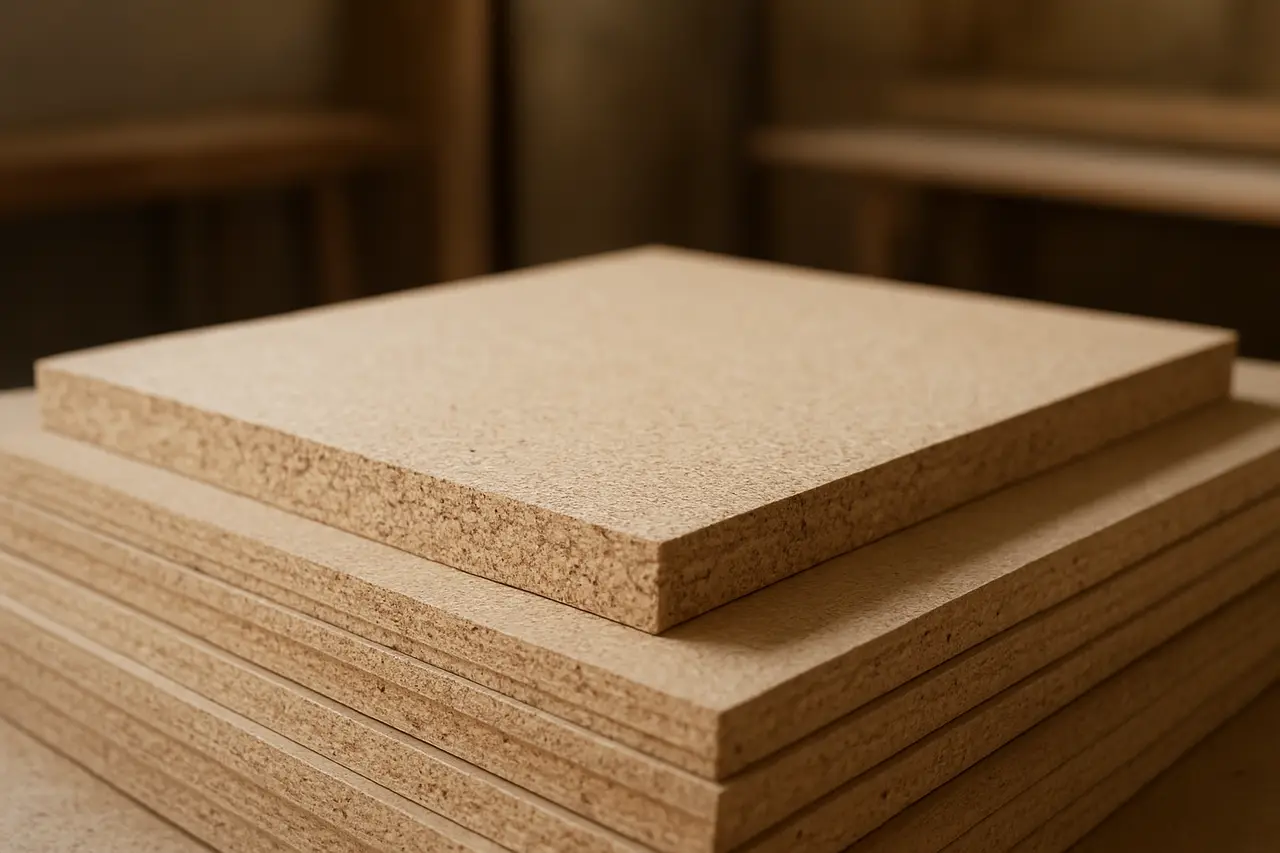
The short answer: A standard 4x8 foot (1.22 x 2.44 m) sheet of 18 mm (0.7 inch) particle board weighs approximately 30 to 40 kilograms (about 66 to 88 lbs). Thinner sheets weigh less.
Particle board weight by type
Particle board is an engineered panel of wood chips and resin. Weight depends mainly on thickness, density and sheet size.
| Thickness (4x8 ft sheet) | Typical weight |
|---|---|
| 12 mm (1/2 in) | 20-27 kg (44-60 lbs) |
| 16 mm (5/8 in) | 27-35 kg (60-77 lbs) |
| 18 mm (3/4 in) | 30-40 kg (66-88 lbs) |
| 25 mm (1 in) | 42-55 kg (93-121 lbs) |
| Per square meter (18 mm) | about 12-13 kg/m² |
What affects particle board weight
- Thickness. Thicker sheets contain more material and weigh proportionally more.
- Density. High-density particle board is heavier than standard or low-density grades.
- Sheet size. Larger panels weigh more for the same thickness.
- Moisture content. Damp boards weigh more than dry ones.
- Laminate or veneer. Melamine or veneer facing adds a little weight.
- Resin content. The amount of binding resin affects density and weight.
How particle board weight compares
A standard 18 mm sheet at around 35 kg weighs about the same as a large bag of cement, or roughly a medium-size dog.
Frequently asked questions
How much does an 18mm particle board weigh per square meter?
An 18 mm particle board typically weighs around 12 to 13 kg per square meter.
Is particle board heavier than plywood?
Often yes. Particle board is usually denser and heavier than plywood of the same thickness.
Does particle board weight change with humidity?
Yes. Particle board absorbs moisture, so a damp sheet weighs more than a dry one and can also swell.